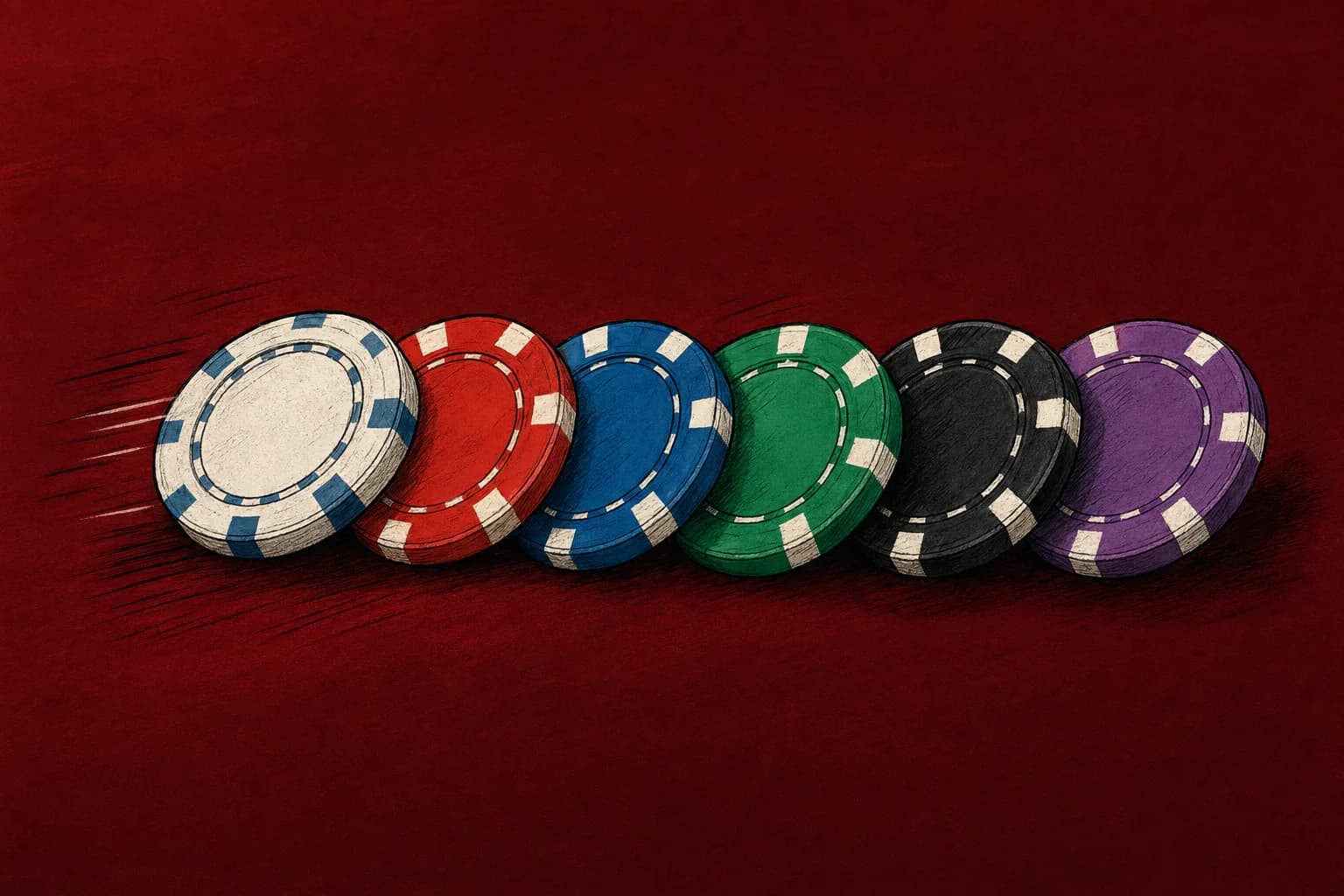
TL;DR The standard poker chip color values are: White $1 · Red $5 · Blue $10 · Green $25 · Black $100 · Purple $500 · Yellow $1,000. Casinos use a slightly stricter version of this, home games can pick whatever they like. For a tournament, distribute chips so 60% of the starting stack is in the lowest two denominations — that gives players room to play before the first level forces an all-in.
Poker chip colors look like decoration. They’re not. They’re a price tag. The colors casinos use today come from frontier-era gambling halls that needed to tell stacks apart from across a smoky room — and most of the basic palette has stayed the same ever since.
This guide covers what each color is worth in a casino, how home games adapt the convention, the slang you’ll hear at the table, and — the part most "poker chip values" articles skip — how to actually distribute them when you sit down to run a tournament.
The standard poker chip values
There’s no single global standard, but the chart below covers what you’ll see in 90% of casinos and tournaments worldwide.
| Color | Common Value | Where you’ll see it |
|---|---|---|
| White | $1 | Lowest denomination, almost universal |
| Red | $5 | The "nickel" — used everywhere |
| Blue | $10 | Common in cash games, sometimes used as $1 in casinos |
| Green | $25 | The "quarter" — mid-stakes workhorse |
| Black | $100 | High-stakes cash games, tournament chips |
| Purple | $500 | High-stakes tournaments and cash games |
| Yellow | $1,000 | Major tournaments and high-roller events |
| Pink | $2,500 | High-roller and final-table chips |
| Orange | $5,000 | World Series of Poker, Triton, etc. |
| Light Blue / Gray | $10,000+ | Top-of-stack at high-roller events |
Casinos in Las Vegas mostly follow these colors. Casinos in Macau, the UK, and parts of Europe sometimes swap blue and green or use entirely different palettes — when in doubt, look at the value printed on the chip.
Casino chip values vs home game chip values
The hard rule for casinos is that every color in the room has a fixed cash value, regulated by the gaming commission. You can walk to any table in the building, drop a black chip down, and you’re betting $100. That standardization is why a chip set you bought online for your kitchen table looks so casino-like.
In a home game, none of that applies. Your white chip can be worth $0.25, $1, or 100 — whatever the room agrees on. Most home games run with one of these conventions:
- Cash games: chip values match real money. White = $1, red = $5, etc.
- Tournaments: chip values are abstract "tournament chips" that don’t correspond to cash at all. A 10,000 starting stack just means 10,000 chips — the buy-in might be $50 or $500 separately.
- Hybrid: small home tournaments where chips loosely represent cents or dollars (a $1 buy-in gets you 100 chips, etc.)
For tournament play, always go abstract. It removes the awkwardness of someone busting out and asking "wait, did I just lose a hundred dollars?" when the buy-in was $20. Use round numbers. Forget the cash equivalence.
Poker chip nicknames you’ll hear at the table
Half the fun of cardroom culture is the slang. A few you’ll run into:
- Nickel — a $5 red chip
- Quarter — a $25 green chip
- Dime — sometimes a $10 chip, sometimes (in poker rooms) a $1,000 chip. Context matters.
- Barney — a $500 purple chip ("barney the dinosaur" → purple)
- Banana / Canary — a $1,000 yellow chip
- Pumpkin — a $1,000 orange chip in casinos that use orange instead of yellow
- Frog — a $25 green chip in some rooms
You don’t need to use any of this. But when the dealer says "rack a barney for the seven seat," you’ll know what’s happening.
How to distribute chips for a tournament
This is where most "chip values" guides stop and where tournament directors actually need help. Here’s the rule that works:
Aim for ~60% of the starting stack in your two lowest denominations. That gives players enough small chips to make real bets in the first few levels without forcing an all-in.
Concretely, for a 10,000 starting stack with blinds opening at 25/50:
| Denomination | Chips per player | Stack value |
|---|---|---|
| 25 (white) | 8 | 200 |
| 100 (red) | 8 | 800 |
| 500 (blue) | 6 | 3,000 |
| 1,000 (green) | 6 | 6,000 |
| Total | 28 | 10,000 |
That’s readable, plays well through the first ~4 levels, and gives you headroom to color up later.
For a 20,000 starting stack at 50/100 blinds:
| Denomination | Chips per player | Stack value |
|---|---|---|
| 25 | 6 | 150 |
| 100 | 12 | 1,200 |
| 500 | 5 | 2,500 |
| 1,000 | 9 | 9,000 |
| 5,000 | 1 | 5,000 |
| Total | 33 | 19,850 |
(Round to 20,000 by tossing in one more 100-chip if you want to be precise.)
For a 50,000 deepstack starting stack at 100/200 blinds:
| Denomination | Chips per player | Stack value |
|---|---|---|
| 100 | 10 | 1,000 |
| 500 | 8 | 4,000 |
| 1,000 | 10 | 10,000 |
| 5,000 | 7 | 35,000 |
| Total | 35 | 50,000 |
The key constraint: don’t hand out so many chips that players need two stacks just to count their stack. Around 25–35 chips per player is the sweet spot. Less than that and the bets feel chunky; more than that and stack-counting becomes its own minigame.
If you don’t want to do this math by hand for every tournament, NextBlind’s tournament manager has a chip calculator built in — it figures out the distribution from your starting stack and the chips you have on hand.
How many chips do you need for a poker tournament?
Quick rule:
- 6–9 players: a 300-chip set in 4 colors handles it.
- 10–18 players: 500 chips in 4–5 colors.
- 18–30 players: 750–1,000 chips in 5 colors. You’ll need to color up at least once during the tournament.
- 30+ players: 1,000+ chips, plus a plan for re-stocking the chip rack between rebuys.
Two things to plan for that first-time hosts forget:
- Rebuys multiply chip demand. Every rebuy adds a full starting stack to the chips in play. If you allow unlimited rebuys, plan for 1.5–2× the chip count.
- Color-up reduces total chip count. Once the lowest denomination becomes irrelevant (because the smallest blind is ten times its value), the dealer pulls those chips off the table and trades players up. After a color-up, you have far fewer chips on the table — which is the goal.
Color-up: when to pull chips off the table
Color-up is the casino term for swapping low-value chips for higher-value ones mid-tournament. It happens once a denomination stops mattering — usually when the smallest blind is at least 10× the lowest chip in play.
Example: you started with 25-value chips at 25/50 blinds. By the time blinds reach 500/1,000, those 25-chips are worthless dust. The dealer announces a color-up break, every player counts their 25s, and the floor swaps them for 100s (rounding up to keep things simple).
The rule of thumb: schedule color-ups around natural breaks. Don’t do them mid-level — it slows play and breaks the rhythm. In NextBlind, you can build a structure with breaks aligned to color-up moments, and the timer announces the break automatically.
Picking a chip set for your home game
For a home game, what matters more than color is denomination spread and chip count. Three principles:
- 3 colors is enough for casual cash games. White, red, green. Done.
- 4 colors fits 90% of home tournaments. White, red, green, black. You can run a multi-table event with this.
- 5 colors only matters if you’re playing deepstack. Add purple ($500) or blue ($25 if you skip green) when stacks get big enough that 100s are tedious to count.
A 500-chip set in 4 colors is the home-game default for a reason. It runs a 12-player tournament without strain, lets you split the chips across two tables if needed, and leaves room for rebuys.
If you’re investing in a set: clay or ceramic chips weigh 11–13 grams, plastic chips weigh 4–6 grams. The weight difference is what makes casino-grade chips feel "real" — but for a kitchen-table game, plastic is fine and a quarter the price.
Poker chip values FAQ
What are the values of each poker chip?
The standard cash-game values are White $1, Red $5, Blue $10, Green $25, Black $100, Purple $500, Yellow $1,000. Higher denominations (Pink $2,500, Orange $5,000, Light Blue $10,000+) appear at high-stakes tournaments.
What color is a $10,000 chip?
Light blue or gray in most casinos. Some properties use white-with-a-color-stripe instead. At the World Series of Poker, the $10,000 chip is sometimes a custom color unique to the event.
What is a $500 chip called?
A "Barney" — slang from the chip’s purple color (Barney the Dinosaur). You’ll also hear "purple" or just "five-hundred."
What color is the most valuable poker chip?
In a typical casino: light blue or gray, worth $5,000–$10,000+. At high-roller events: custom colors above that. At home games: whatever color you decided to make the highest value.
How many chips do you start with in a poker tournament?
Tournament starting stacks range from 1,500 (turbo events) to 100,000+ (major-event deepstacks). The most common starting stacks for home and club tournaments are 10,000, 20,000, or 50,000 chips. The actual number of physical chips per player should be 25–35 — split across 3–5 denominations.
How much is a casino chip worth?
It depends entirely on the casino and the chip color, but the value is printed or molded onto the chip itself — you can read it. The same color can mean different values at different properties (one room’s $25 green is another room’s $20).
The bottom line
Poker chip values are simpler than they look. Casinos standardize them by color, home games can do whatever they want as long as the room agrees, and tournament chips don’t correspond to cash at all — they’re just an abstract count.
The harder part is figuring out chip distribution — how many of each denomination to give each player so the game plays smoothly through the first few levels without anyone needing two hands to count their stack.
NextBlind handles that automatically. Pick a starting stack, the chip calculator gives you a distribution, and the tournament timer takes care of color-ups and breaks. Try it free — no app, no install, no card.