A bounty poker tournament pays you twice. Once for finishing in the money like any other tournament, and once every time you knock somebody out. That changes how players bet, how aggressively they call short-stack jams, and how the prize pool is structured.
If you host a home game and want to try a format that plays differently from a standard freezeout, this is the one. The setup is simple, the math is forgiving, and the table dynamics shift in a way players notice immediately.
What a bounty poker tournament is
A bounty tournament is a knockout tournament. Every player has a price on their head, and whoever eliminates them collects it. The rest of the buy-in goes into a regular prize pool that pays the final places.
Concrete example. A $100 bounty tournament typically splits the buy-in 50/50: $50 goes to the prize pool, $50 sits as a bounty on each player. Knock somebody out, you collect their $50 in cash on the spot. Make the final table, you also win prize-pool money based on finishing position.
The bounty is yours to keep even if you bust later. You walked over to seat 4, knocked them out, pocketed their $50, and that money is locked in regardless of what happens to your stack. People who bust early in a bounty event still leave with money in their pocket if they got a knockout or two on the way out. That asymmetry is the whole appeal.
A few rules worth setting before cards come out. The eliminator gets the full bounty unless the format specifies a split (progressive knockouts split it). If two players bust on the same hand, the bounty goes to whoever covered them at the start of the hand. House rules vary, so agree before the first deal. A bounty is only collected when a player is fully eliminated from the tournament, not when they double up against you.
The four bounty formats you will actually see
Standard knockout (KO)
Every player has a fixed bounty equal across the field. Buy in for $100, $50 sits on your head, $50 goes to the prize pool. Whoever knocks you out takes the $50 in cash. Simple, predictable, and easy to run at a home game with no special accounting.
Progressive knockout (PKO)
The bounty grows as the player accumulates knockouts. When you eliminate someone, you take half their accumulated bounty in cash and add the other half to your own head. So if you knock out three players in a row, your bounty has snowballed and you are now a much more valuable target. PKO is the format most online sites use because it concentrates money toward late-stage play.
Mystery bounty
Every player has a bounty, but the amount is unknown until late in the tournament. Once the field reaches a set point (usually the money bubble or the final two tables), the structure switches: every elimination from that point earns you a random bounty drawn from a pool. Bounties are weighted, with most being small and a few being big enough to flip the night. Mystery bounty is the format the World Series of Poker popularized in 2022, and it has spread to almost every major tour since.
Super knockout
Most of the buy-in is the bounty. A $109 super KO might allocate $100 to bounties and $9 to the prize pool plus rake. The whole tournament becomes a scramble for knockouts, and finishing position barely matters. Aggressive players love it. Tight players hate it.
How to split the buy-in between prize pool and bounty
For a home game, the math matters because the players need to know what they are paying for.
The standard split for a regular bounty event is 50/50. A $50 buy-in becomes $25 prize pool, $25 bounty. That keeps the prize pool meaningful for late finishers while still giving real money for knockouts.
For a progressive knockout, the split inside the bounty portion is also 50/50: knock somebody out, half goes in your pocket, half adds to your bounty. So a $25 bounty paid into the pool becomes $12.50 in cash and $12.50 added to the eliminator's head.
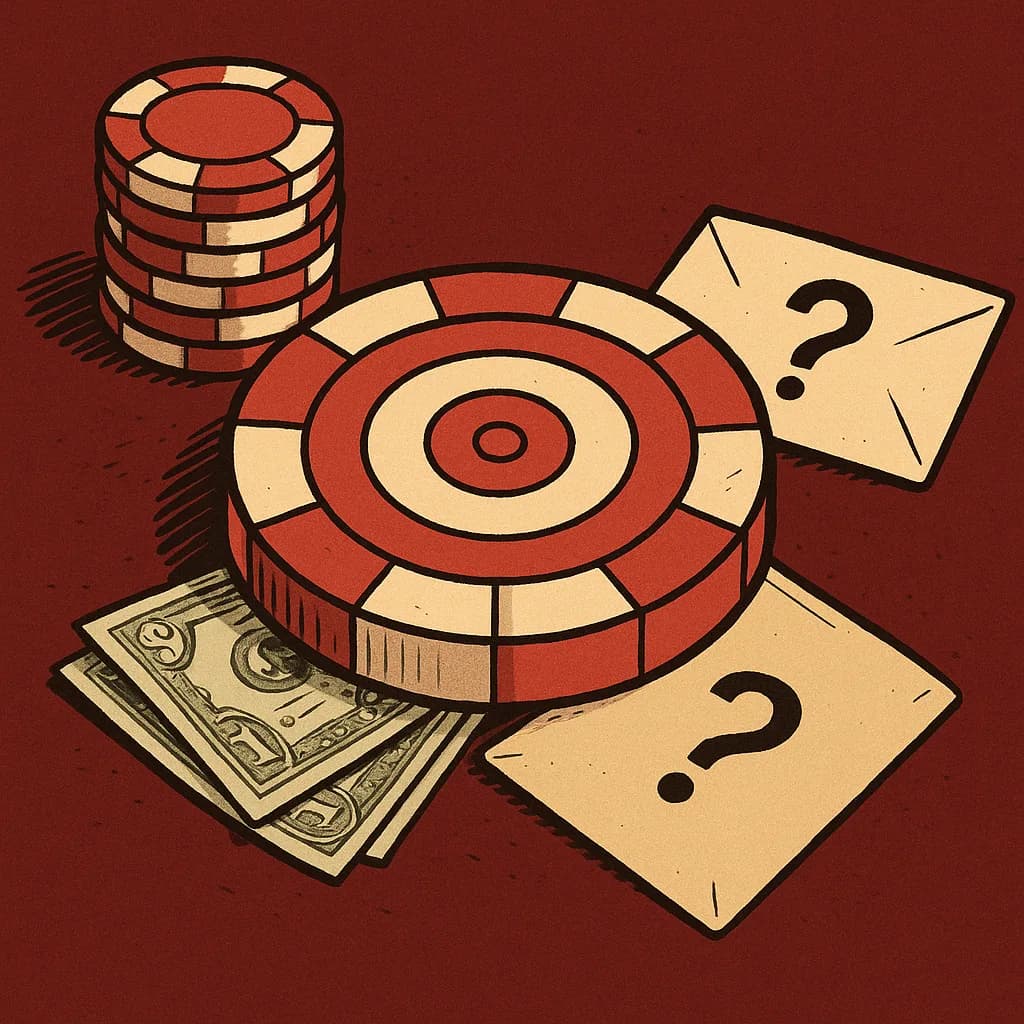
For a mystery bounty, the split is usually 40% prize pool, 60% mystery pool. The mystery pool is then divided into envelopes (or chips drawn from a bag) with a defined distribution. A 30-player $100 buy-in mystery event would have $1,800 in the mystery pool. A workable distribution:
- 1 envelope of $500 (the grand bounty)
- 2 envelopes of $200
- 4 envelopes of $100
- 8 envelopes of $50
- 15 envelopes of $20
That gives 30 envelopes total, one for each player, with most being small and a few being meaningful. Once the bounty round triggers, the player who knocks somebody out draws an envelope.
The general rule: the prize pool should be at least 30% of the total. Below that and finishing position stops mattering, which kills late-stage play. The point of a tournament is still to win it.
Running a bounty tournament at a home game
The mechanics are simpler than they sound. You need three things: a way to mark each player's bounty, cash on hand to pay out, and a clear rule for who counts as the eliminator.
The cleanest method is physical bounty chips. Buy a small set of distinctive chips that do not match your tournament chips (plain metal poker coins work well). When somebody pays the buy-in, hand them their bounty chip. They keep it in front of their stack. When they bust, the eliminator takes the chip and trades it in for cash either at the end of the night or right then if you have the cash on the table.
Bounty chips beat cash on the table because cash is awkward to handle, easy to lose, and tempting to grab. Chips are visible, traceable, and feel like part of the game.
For mystery bounty, use sealed envelopes or a covered bowl with poker chips marked with values inside. When somebody knocks a player out during the bounty round, they pull an envelope, open it at the table, get paid, and play continues.
The rule that prevents arguments: the eliminator is the player at showdown with the better hand who covered the busting stack. If the busting player went all-in pre-flop and three players are still in the hand, the bounty goes to whoever had them covered when they put their last chips in, regardless of who wins the side pot. Settle this language before the tournament starts. People will argue about a $50 bounty harder than they argue about a $200 prize-pool difference.
How the bounty format changes correct play
Bounty money distorts the math of every all-in. In a standard freezeout, calling a 10-big-blind shove is a question of equity against the price you are getting. In a bounty event, you also need to add the bounty value to the pot.
Concrete example. Blinds 500/1,000. You are sitting on 30 big blinds. The short stack at 8 big blinds shoves. The pot before you act is roughly 9.5 big blinds plus the bounty. If the bounty is worth 5 big blinds in chip equivalent, you are effectively calling 8 to win 14.5 plus the bounty. That is a much wider call than a freezeout.
Two practical adjustments. Call short-stack shoves wider, especially when you cover them. The bounty is only collectible if you knock the player out, which means you have to cover their entire stack. If the short stack covers you or it is close, treat the hand like a normal freezeout. You cannot win the bounty if you cannot eliminate them.
In progressive knockouts, the math gets more lopsided. A player with three accumulated knockouts has a much bigger bounty than someone fresh off the rebuy line. Late in a PKO, table selection and seat selection start to matter. Sitting to the left of the biggest bounty, where you act after them post-flop, is a real edge.
Mystery bounty changes things differently. Before the bounty round triggers, play is a normal freezeout. After it triggers, every elimination has option value, but the amount is random. The correct adjustment is smaller than in a known-bounty PKO because most envelopes are small and you cannot price in the rare grand bounty without overadjusting.
Building the structure in your tournament timer
A bounty event runs on the same blind structure as a regular tournament. A 90-minute home game with 25-minute levels works fine. A four-hour club night with 40-minute levels works fine too. You do not need to shorten levels just because it is a bounty event.
What you do need to track separately is the bounty round trigger if you are running a mystery bounty. Set a clear marker, either half the field eliminated or a specific blind level, and announce it loudly when it happens. NextBlind lets you add custom level announcements, so you can have the timer say "mystery bounty round begins now" automatically when you cross your trigger.
Beyond that announcement, the timer treats it like any other event. Blinds escalate, breaks happen, and the bounty layer runs alongside without any extra timing logic.
Bounty tournament FAQ
How is a bounty calculated?
Take the buy-in and split it. The most common split is 50/50: half the buy-in goes to the prize pool, half becomes the bounty on that player's head. A $100 buy-in becomes a $50 bounty and $50 toward prize money.
Do bounties actually get paid?
At a home game, yes. Either paid on the spot in cash or settled at the end of the night against bounty chips. Online and at casinos, bounties land in the player's account or chip stack instantly.
What is a grand bounty in a poker tournament?
A grand bounty is the top prize in a mystery bounty event, usually 5-10x the average envelope value. It exists so the late-tournament chase still feels meaningful after most of the small bounties have been claimed.
What is the difference between a bounty and a knockout tournament?
Nothing. They are the same format described two different ways. "Bounty" emphasizes the money on each player's head. "Knockout" emphasizes the elimination mechanic.
Can you win a bounty without busting the player?
No. The bounty only transfers when the player is fully eliminated from the tournament. Doubling up against them or winning a single pot does not collect their bounty.
Try one at your next home game
A bounty event is the easiest format change to make once you have run a few standard freezeouts. The blind structure carries over from a normal freezeout, the chip stacks stay the same, and you only need to add a roll of cash and a set of bounty chips. Tell players the eliminator rule before the cards come out, write the buy-in split on a whiteboard, and let it run. Players who normally fold tight pre-flop start opening hands they would not, the early levels get more entertaining, and a 12th-place bustout often still ends with the player up money for the night.