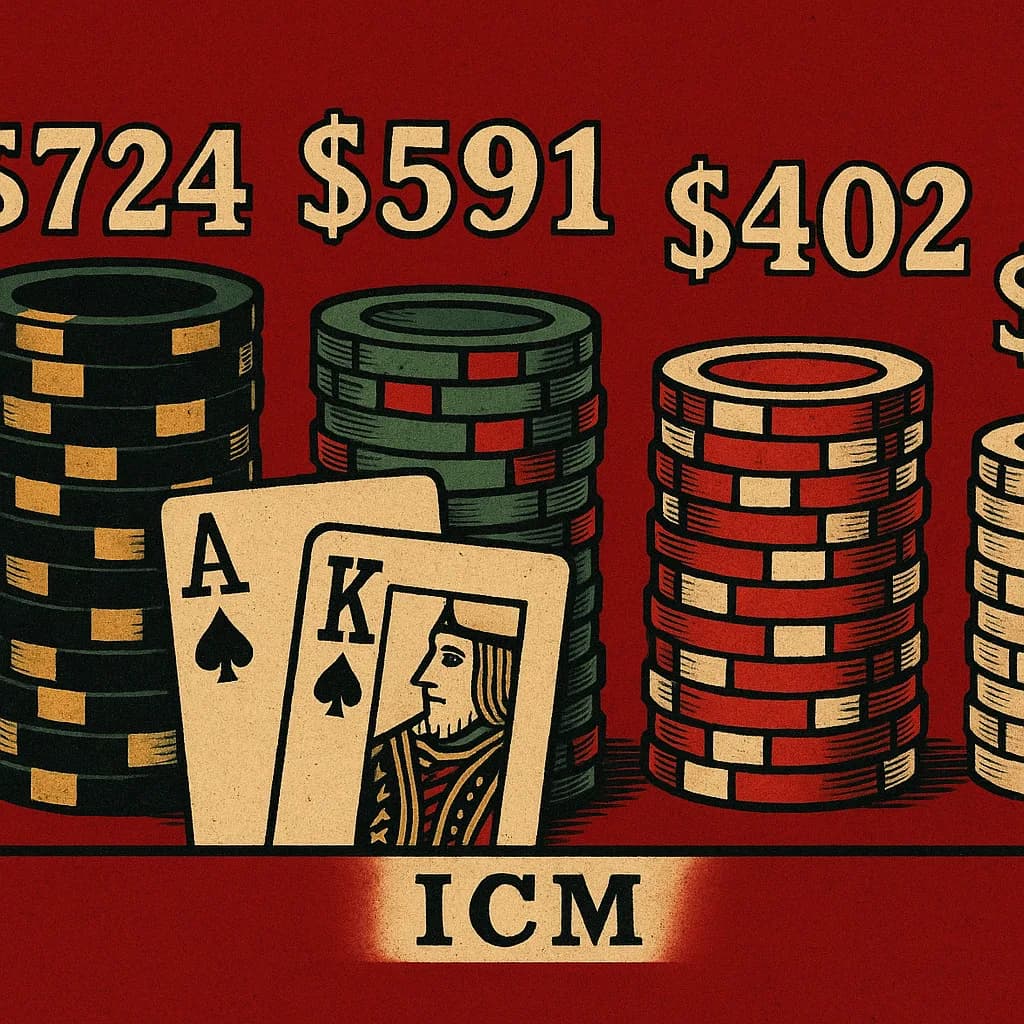
TL;DR ICM (Independent Chip Model) converts tournament chip stacks into dollar equity using the prize pool and payout structure. A player with 50% of the chips does not have 50% of the prize pool. They typically have closer to 35-40%, because second and third place still pay. The model matters most at final tables, on the bubble, and any time players ask to chop the pot.
ICM is the math behind every "should we deal?" conversation at a final table. Most home-game hosts and club organizers run into it the moment three players want to negotiate a payout split, and most do not know the calculation actually has a name.
This post explains what ICM is, walks through a worked example with real numbers, shows how it changes correct strategy on the bubble, and covers the limits of the model so you do not trust it more than you should.
What ICM actually is
The Independent Chip Model is a formula that takes the chip counts of every remaining player in a tournament and outputs each player's expected dollar value of finishing in each paid place. Add those up across every place and you get each player's total tournament equity in dollars.
It is called "independent" because the model assumes the next chip you win is just as likely to come from any opponent in proportion to their stack. That is a simplification. Skill, position, and player tendencies do not enter the math. But it is accurate enough for the use case it was built for: estimating prize-pool equity when players want to chop.
The model was first formalized by Mason Malmuth and David Harville in the 1980s. Every modern ICM calculator implements the same recursive computation under the hood: probability of each player finishing first, then second, then third, weighted by the payout for each place.
You will hear ICM used in two different ways at the table. One is "ICM equity," meaning the dollar value of a stack right now. The other is "ICM pressure," meaning the strategic adjustments players make because their chip-EV and dollar-EV no longer match. Both come from the same underlying math.
Chip EV vs dollar EV: why they are not the same
In a cash game, every chip in front of you is worth its face value. Win a 1,000-chip pot and you have gained $1,000 of equity. Tournaments break that.
In a tournament, you cannot redeem chips for cash until you bust, and even then you only get paid if you finish in a paid place. The prize pool is fixed, the payouts are top-heavy, and the last chip you win is worth less than the first one. This is the part most players miss.
Chip EV = your share of the chips in play, times the prize pool.
Dollar EV (ICM) = the probability-weighted dollar value across every possible finish.
Concretely: if you go from 30% of the chips to 60% of the chips by winning a coinflip, your chip EV doubles. Your dollar EV does not. Your chance of winning first goes up, but your chance of busting before the money also goes up, and second through fourth still pay. The ICM model captures that asymmetry.
The practical takeaway: doubling your stack never doubles your tournament equity. Halving it usually loses less than half. That is why short stacks feel "chip pressure" and big stacks have outsized influence at the bubble.
A worked ICM example with four players
Let's run a real calculation. Four players left in a $100 buy-in tournament with twenty entrants, so the prize pool is $2,000. Standard 50/30/15/5 payout:
| Place | Percentage | Payout |
|---|---|---|
| 1st | 50% | $1,000 |
| 2nd | 30% | $600 |
| 3rd | 15% | $300 |
| 4th | 5% | $100 |
Stacks at the final table:
| Seat | Player | Chips | % of chips |
|---|---|---|---|
| 1 | Alice | 100,000 | 50% |
| 2 | Bob | 60,000 | 30% |
| 3 | Carol | 30,000 | 15% |
| 4 | Dan | 10,000 | 5% |
Chip-EV alone would say Alice owns 50% of the prize pool ($1,000), Bob owns $600, Carol $300, Dan $100. That is wrong. ICM gives each player a probability of finishing in each place (Dan can still win, Alice can still bust 4th) and weights the payouts.
Running the standard ICM calculation on these stacks produces:
| Player | Chip-EV | ICM equity | Difference |
|---|---|---|---|
| Alice | $1,000 | $724 | -$276 |
| Bob | $600 | $591 | -$9 |
| Carol | $300 | $402 | +$102 |
| Dan | $100 | $283 | +$183 |
The chip leader is worth $276 less than her chip percentage suggests. The short stack is worth nearly 3x his chip-EV, because finishing 4th is the worst case and he is already nearly guaranteed at least the 4th-place payout of $100.
This is why short stacks accept chop deals that look "unfair" by chip count: ICM says they are underpriced if you only count chips. And it is why big stacks resist those same deals.
ICM and final-table deals
The most common place a home-game host or club director runs into ICM is when players ask to chop the prize pool at the final table.
There are two standard chop methods. The chip-chop divides the remaining prize pool (everything above the lowest guaranteed payout) by chip percentage. Simple, fast, but unfair to short stacks and overgenerous to chip leaders. The ICM chop uses each player's ICM equity as the payout. Mathematically fair, accepted at every casino, but requires a calculator and a few minutes to compute.
The compromise that works Pay each finalist the lowest remaining payout first. Then split the leftover prize pool by ICM. That guarantees every player at least the next pay jump and removes the "what if I bust right after we agree" risk.
For the four-player example above, the 4th-place payout is $100. Pay each player $100 up front ($400 total), then split the remaining $1,600 by ICM equity:
- Alice: 1,600 × 0.362 = $579, plus $100 floor = $679
- Bob: 1,600 × 0.295 = $472, plus $100 floor = $572
- Carol: 1,600 × 0.201 = $321, plus $100 floor = $421
- Dan: 1,600 × 0.142 = $227, plus $100 floor = $327
Total: $1,999. The $1 rounding loss goes to the bubble or the dealer.
Most home games skip the math and split the pot evenly or by chip count. ICM is what casinos use when a deal is requested at a final table, and it is the only common method that does not systematically rob the short stacks.
Strategy implications: how ICM changes correct play
Once you understand that chip-EV and dollar-EV are different, several "obvious" decisions reverse.
Calling all-ins gets tighter near the money. A chip-EV breakeven call (say, 53% to win when you are getting 1.1-to-1 pot odds) can be a clear ICM fold if the pay jump from busting next to cashing is large. You are trading a small chip gain for a much larger swing in dollar equity.
Big stacks should pressure medium stacks. The medium stacks have the most ICM pressure. They have the most to lose by busting before the short stack does. A big stack can shove wide into a medium stack, and the medium stack is forced to fold hands they would snap-call in a cash game.
Short stacks should shove wider. The short stack has the least ICM pressure. They are already being paid mostly for finishing in the bottom paid spot, and the upside of doubling up is enormous in chip equity. Hands that look thin in chip-EV terms (any ace, most pocket pairs, suited connectors) become correct shoves once you are at 8-12 big blinds.
Bubble play favors the chip leader. On the money bubble, every non-leader is trying to fold into the money. The chip leader can raise nearly every hand without committing chips. This is why the term "ICM pressure" mostly means "what the big stack does to everyone else."
Limits of the ICM model
ICM is a simplification. The places it breaks down are worth knowing.
It assumes equal skill. The model treats every player as a coin-flip-equity opponent for chips. Real tables have skill gaps, and a strong player's true equity is higher than their ICM number suggests.
It ignores position and blind structure. ICM has no concept of who is about to be in the big blind. In a turbo where the big blind is 20% of your stack next hand, your real equity is lower than ICM says.
It does not model future chip movement. ICM is a snapshot of right-now equities. As stacks shift across the next few hands, the equities recalculate. The model cannot predict that path.
For final-table deals, those limitations do not matter much. The point of ICM at a chop is fairness, not predictive accuracy. For mid-tournament strategy decisions, treat ICM equity as a baseline and adjust for skill, position, and stack pressure.
Where to use ICM in your tournaments
If you host home games or run a poker league, the practical answer is: pull up an ICM calculator the moment players want to negotiate a deal. Type in the chip counts and the remaining payouts, read out the numbers, and let the math end the argument. It takes two minutes.
For tournaments that reach a final table on a regular basis (leagues, club nights, monthly home games), print an ICM equity table into your structure sheet so players see the numbers a few times before the chop conversation comes up. Once the math is familiar, deal-making goes from a stalemate to a routine.
NextBlind's payout calculator handles the structure side of the math: prize pool, place percentages, dollar payouts. For the chop itself, a dedicated ICM tool is still the right answer, and now you know what it is actually computing.